Diplomas

Diploma Health and safety
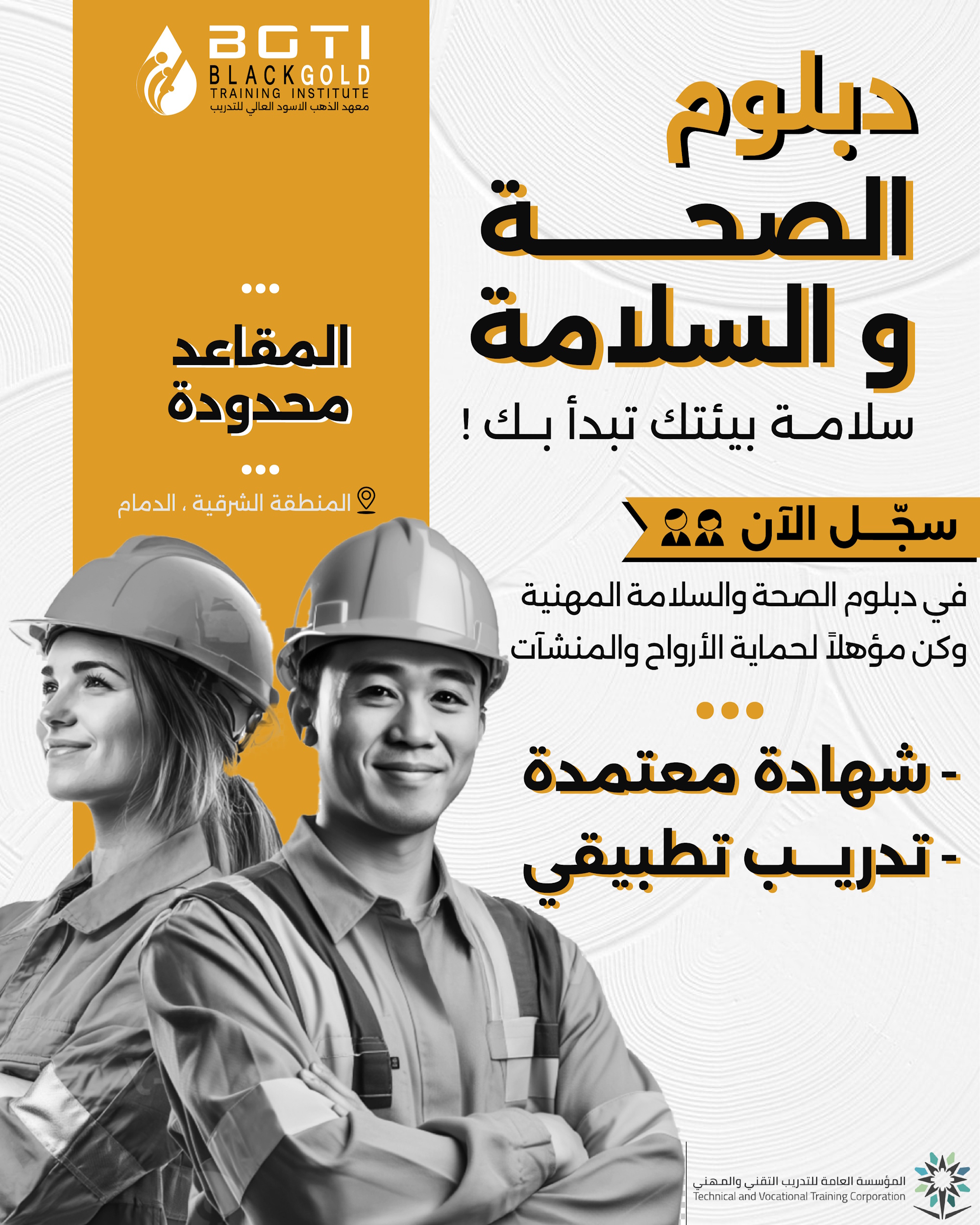
Health and safety diploma
Training in this program is carried out on the specialized skills necessary for the labor market, a mechanism in the field of Occupational Safety and health, a mechanism for identifying and controlling risks and emergency response. during the training, the emphasis is on the practical applied side and linking it with the theoretical side in most of the specialty courses and studying the impact of chemicals The most prominent administrative systems currently available for Occupational Safety and health at the facility level, as well as studying, inventorying and classifying risks and developing the most appropriate solutions to remove These are risks.
The program describes the various occupational safety and health management systems, including OHSAS18001, ILO-OSH, ISO45001 and other leading local and international occupational safety and health management systems.
* Scientific degree
The intermediate diploma is classified at the fifth level of the national framework of qualifications.
* Duration of training
Two and a half years
* Target group
Men and women
* Available branches
Dammam branches in the eastern region
* Mandatory requirements
3 and a half months cooperative training
- Overall objective
- Outputs
- Study plan
- Target groups for this course
- The most important features of the diploma
- Areas of work
This program aims to provide the trainee with the skills and information necessary to practice work in the field of Occupational Safety and health.
- 1. He knows the relevant local, regional and international regulations and legislations in the field of Occupational Safety and health by reviewing them for application in the fields related to his work.
2. Classifies the hazards of chemicals and biological organisms in the appropriate way to find out their possible effects .
3. Designs awareness programs in an appropriate way to publicize their seriousness at the organizational level.
4. Identifies the causes of accidents by familiarizing and monitoring the environment, equipment, tools and technical reports to develop preventive measures.
5. He makes sure that the workers are free from obvious pathological symptoms by observation to prevent the injured worker from working.
6. The administrative systems for Occupational Safety and health are defined by reviewing and reviewing to benefit from each system according to the need of the facility.
7. Fights fires of various types with appropriate tools and devices to reduce losses in human and material resources.
8. Monitors the safety of the work environment by reviewing and monitoring the systems and procedures organized to identify sources of pollution of the internal work environment and create a safe work environment free of pollution.
9. Defines the roles and responsibilities of the entities related to occupational safety and health locally, regionally and globally by reviewing the legislations and laws regulating this to highlight the role of each entity and determine its responsibilities accurately.
10. Implements on-site emergency plans in the appropriate manner and tools to identify roles and responsibilities and how to deal with them before, during and after the occurrence of accidents.
11. Participates in evacuation and first aid plans according to the established procedures to contribute to the proper provision of emergency services, evacuation and preservation of the lives of the injured.
12. Investigates various accidents according to the competence, responsibilities and tasks assigned to him through written procedures and training of specialists to reach the causes of the accident to prevent its recurrence.
13. Prepares the work area in a correct way that is appropriate to the worker's abilities to reduce the risk of performance-related injuries or stress.
14. Inspects working environments and workers with visits and careful follow-up of reports to maintain the safety of the working environment and workers.
15. Equipping workers and equipment at drilling sites and applying Occupational Health and safety procedures.
| Training class | Course name | Training class | Course name |
|---|---|---|---|
| Chapter One: the first level | Islamic studies | Chapter Three: the first level | Introduction to statistics |
| Career guidance and excellence | Fire fighting | ||
| Introduction of Computer Applications | Safety of the working environment | ||
| General chemistry | Occupational health | ||
| Chapter One: the second level | Mathematics | Chapter Three: the second level | English language-3 |
| English language-1 | Occupational Safety and health regulations and regulations | ||
| Introduction to ecology | Traffic Safety | ||
| Introduction to occupational safety and health | Emergency response | ||
| Chapter Two: the first level | Technical writing | Chapter IV: the first level | Career behavior and communication skills |
| Learning skills | Data analysis using computer applications | ||
| Toxicology | Evacuation and first aid | ||
| Risks in the industry | Accident Investigation | ||
| Chapter Two: the second level | English Language-2 | Chapter IV: the second level | |
| Human factors | Field inspection | ||
| Risks in construction | Project | ||
| Occupational Safety and health management system | Chapter V | Cooperative training 2,1 |
* High school graduates of various levels.
* Those interested in the field of Occupational Safety and security.
* Employees of the government and private sectors.
* Occupational Safety and security officials.
* Managers, heads of departments and supervisors of Occupational Safety and security.
* Qualify you for the certificate of OSHA (OSHA), nubish (NEBOSH), Ayush (IOSH)…
* The course certificate is accredited by the General Organization for technical and vocational training.
* The certificate increases the strength of the file of trainees and applicants to the labor market.
* There are easy payment options (the same as cash fees).
* Occupational Safety and health specialist.
•
* The industrial sector of all kinds.
* The health sector in its various forms.
* Civil Defense and National Guard bodies
* Occupational Health and safety management in the military sector and the police.
* Private consulting offices related to occupational health and safety.
* Regulatory sector such as the Meteorological Authority, Environmental Protection, Food and Drug Authority.
* The government sector such as municipalities, secretariats, Ministry of Environment, Water, and agriculture.